The Customer Decision Journey (CDJ) — Complete 4-Stage Guide for the AI Search Era
The CDJ (Customer Decision Journey) maps the path from problem recognition to purchase across 4 stages: Awareness, Consideration, Decision, and Loyalty. In the AI search era, each stage is increasingly mediated by AI answers — brands must design content to be cited at each stage.
Dohak Kim
Marketing Architect · Ph.D. in International Marketing (UIBE)
Published
2026-06-04
Summary
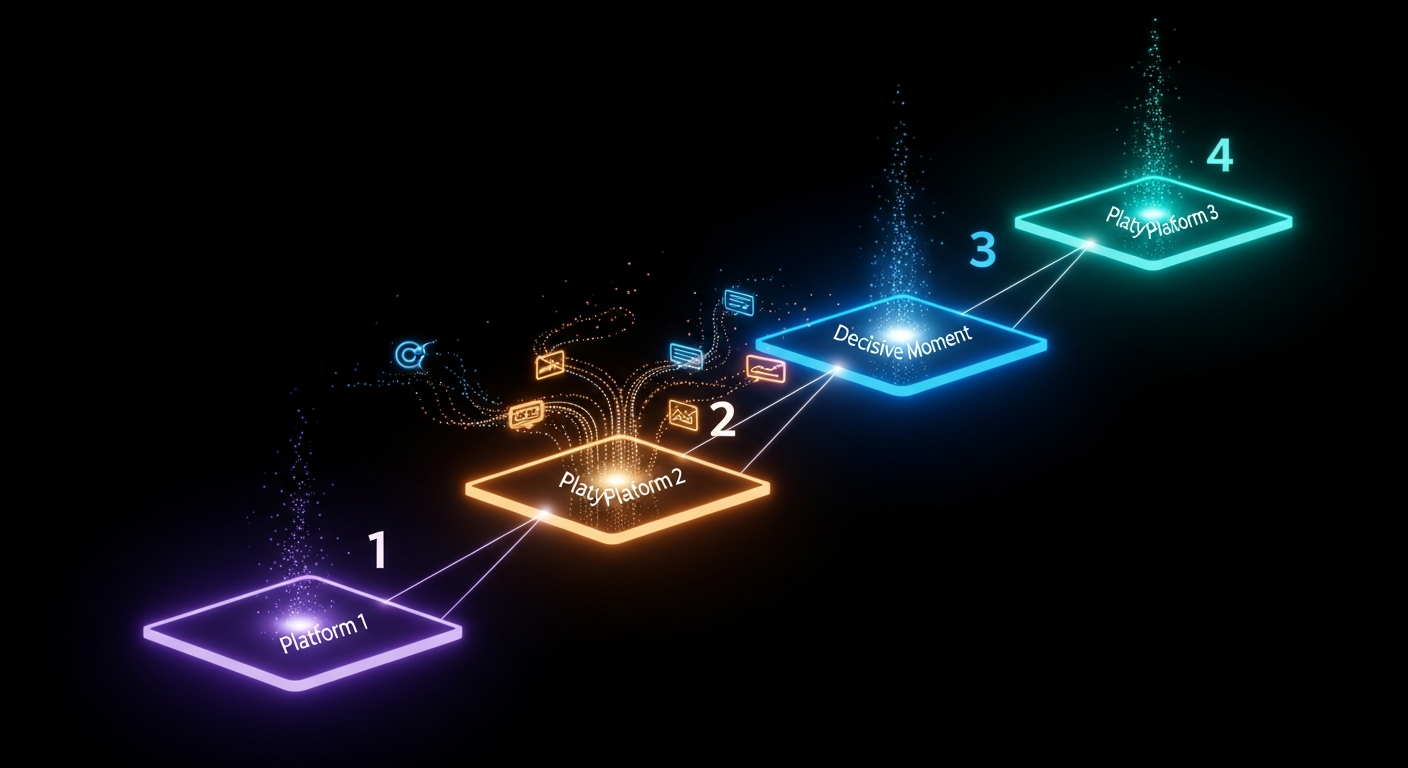
The CDJ (Customer Decision Journey) structures the consumer purchase path as 4 stages: Awareness → Consideration → Decision → Loyalty. In the AI search era, consumers ask AI different questions at each stage — and brands must have content designed to be AI's cited answer at every stage, not just the final one.
What Is the CDJ? — The 30-Second Definition
The CDJ (Customer Decision Journey) models the full consumer purchase process — from recognizing a problem to making a decision and building post-purchase loyalty — across 4 stages: Awareness → Consideration → Decision → Loyalty.
In Project AEGIS's C³ Cube, the CDJ is reimagined as the Conversion (C²) axis — going beyond observation of the journey to mapping what content AI answer engines cite at each stage, then activating those citations as a conversion optimization layer.
How AI Search Has Changed the CDJ
The traditional CDJ assumed a consumer-led linear journey. Marketers placed exposure and persuasion content at each stage and managed the flow. AI search has changed this fundamentally:
- AI mediates information filtering: Consumers no longer browse search results — they ask AI and receive a synthesized answer. AI decides which brands to cite. Whichever brand AI recommends at a given stage shapes the journey direction.
- Stage boundaries blur: "What is this product?" (Awareness) and "this product vs the competitor, which is better?" (Consideration) can occur in a single AI conversation. AI compresses CDJ stages.
- Loyalty stage importance surges: Post-purchase UGC (reviews, case studies) from satisfied customers enters AI training data and influences the next buyer's Awareness stage. The loop is tighter than ever.
The 4 CDJ Stages in Detail
Stage 1: Awareness — "I have a problem"
The consumer first recognizes a need or problem. AI queries at this stage are typically informational: "Why is X happening?", "How does X work?", "What is X?" The consumer is building a mental model of the problem space.
Marketing strategy: Content that precisely defines the consumer's problem and validates that it's worth solving. "This phenomenon you're experiencing exists, here's why it happens" — problem-definition and root-cause analysis content is highly citable by AI at this stage.
AEO application: Problem definition → FAQPage schema. Root cause analysis → Article schema. Solution direction hinting → HowTo schema (early steps only).
Stage 2: Consideration — "What are my options?"
The consumer explores and compares solutions. This is the most AI-query-intensive stage: "A vs B differences," "criteria for choosing X," "best X for [situation]." The most active CEP landscape across the entire CDJ.
Marketing strategy: Transparent and balanced comparison content. AI prefers content that provides objective evaluation criteria over content that purely promotes a single brand. Explicit competitor comparisons are effective here — if objective and fair.
AEO application: Comparison tables → Table structure. Selection criteria → HowTo schema. Comparison Q&As → FAQPage schema.
Stage 3: Decision — "I've decided"
The consumer narrows to the final choice. AI queries shift to transactional: "pricing," "refund policy," "real reviews," "where to buy." Trust confirmation and friction removal are the priorities.
Marketing strategy: Trust building and barrier removal. FAQ content that directly answers purchase objections. Explicit pricing, terms, and guarantees. Real user case studies that AI can cite as social proof.
AEO application: Pricing and terms → Product schema. Guarantees and policies → FAQPage. Case studies → Article + Review schema.
Stage 4: Loyalty — "Was it worth it? Would I buy again?"
The consumer uses the product or service and forms satisfaction judgments that influence re-purchase and referral. UGC from this stage (reviews, case studies, tutorials) becomes AI training signal for the next buyer's Awareness stage.
Marketing strategy: Convert successful experiences into content. Publish usage guides, advanced tutorials, and success stories. This content simultaneously retains existing customers and becomes the Awareness-stage citation source for future buyers.
Analyzing the CDJ with AEGIS Pathfinder
AEGIS Pathfinder collects live Google and Naver SERP data for any keyword topic and automatically classifies each query into one of the 4 CDJ stages:
- Journey Ladder visualization: A tiered map showing which stage holds the most search volume and where content gaps exist
- Stage-by-stage keyword clusters: Primary queries by CDJ stage
- CEP auto-extraction: Context Entry Points clustered by stage with Priority Scores
- Content gap analysis: Stages where your brand is weaker than competitors
After analysis, clicking "Build Strategy in C³" automatically passes the CDJ insights to C³ Cube Strategy for execution planning.
Content Design Principles for AI Search CDJ
When designing content for each CDJ stage from an AI search optimization perspective:
- Single-stage intent: Don't mix Awareness-stage content with Decision-stage conversion CTAs in the same piece. AI prefers content that satisfies one clear intent per document.
- Inverted pyramid: Open every piece with a direct answer to that stage's core question. Provide evidence and supporting detail after the direct answer.
- Internal linking between stages: Design Hub & Spoke internal links from Awareness-stage content to Consideration-stage content, and from Consideration to Decision-stage content. Guide both consumers and AI crawlers through the complete journey.
- Schema matching: Apply the JSON-LD schema type that best matches the intent of each stage so AI immediately understands content purpose.
Frequently Asked Questions
Q.What is the CDJ (Customer Decision Journey)?
A.The CDJ is a framework modeling the full consumer purchase process as 4 stages: Awareness (recognizing a need) → Consideration (evaluating options) → Decision (committing to a choice) → Loyalty (post-purchase experience and repeat purchase). Each stage generates distinct search and AI query patterns.
Q.How is the CDJ different from the traditional marketing funnel?
A.Traditional funnels (AIDA) assume a linear, one-way flow the brand controls. The CDJ acknowledges that consumers move non-linearly — skipping stages, reversing, and re-entering — and that AI search increasingly mediates every stage simultaneously. A single ChatGPT conversation can compress Awareness through Decision into one exchange.
Q.Which CDJ stage matters most in the AI search era?
A.The Consideration stage is most critical. This is where consumers ask AI the most questions: "A vs B comparison," "criteria for choosing X," "best X for my situation." If AI cites your brand positively at this stage, it often directly drives the Decision stage without requiring additional touchpoints.
Q.What content should CDJ analysis drive?
A.Awareness: problem-definition content ("Why does X happen?"). Consideration: comparison and evaluation content ("A vs B differences," "how to choose X"). Decision: trust-building content (pricing, FAQ, guarantees, social proof). Loyalty: advanced usage guides, success stories, UGC generation.
Q.How does AEGIS Pathfinder analyze the CDJ?
A.Input a search topic and Pathfinder collects live Google and Naver SERP data, automatically classifying each search query into one of the 4 CDJ stages. It returns stage-by-stage content gaps, Journey Ladder visualization, and CEP clusters — then automatically passes the analysis to C³ Cube Strategy.
Q.How are CDJ and CEP related?
A.A CEP (Context Entry Point) is the specific situational moment that triggers a consumer to enter a CDJ stage. Each CDJ stage contains multiple CEPs with different contexts and intents. In C³ Cube, CDJ maps to the Conversion (C²) axis and CEP maps to the Context (C¹) axis — strategy is built at their intersection.
How to Apply This — Step by Step
- 1
Map the CDJ
Run AEGIS Pathfinder with core category keywords to automatically map consumer search patterns across the 4 CDJ stages. Review stage-by-stage keyword distribution and identify content gaps.
- 2
Identify Stage-Specific CEPs
Extract the Context Entry Points (CEPs) at each CDJ stage using AEGIS Signal. Each stage's CEPs differ in context and intent — they each require different content strategies.
- 3
Design Stage-Specific Content
Awareness stage: problem-recognition content. Consideration: comparison and evaluation content. Decision: FAQ and trust-building content. Loyalty: success stories and UGC-generating content.
- 4
Build C³ Cube Strategy
Pass Pathfinder analysis data to C³ Cube Strategy to auto-generate stage-by-stage Hub & Spoke content structure and triple-media (Owned, Earned, Paid) strategy.
- 5
Generate Content with FORGE
Send the C³ ExecutionPlan to AEGIS FORGE to auto-generate AEO/GEO-optimized content for each CDJ stage. Publish and track AEO score changes with AEGIS Insight.
More in CDJ Strategy