AEGIS Index Methodology — Measurement Reliability and Result Interpretation Guide
A complete breakdown of the AEGIS Index (SEO×0.25 + AEO×0.25 + GEO×0.50): all 38 metrics, the T1 structural scan vs T2 AI analysis reliability system, Critical Fail gating, and how to correctly interpret your score and scenario.
Dohak Kim
Marketing Architect · Ph.D. in International Marketing (UIBE)
Published
2026-06-06
Summary
The AEGIS Index measures AI search visibility across 38 metrics in two stages. T1 structural scanning (~100% reproducibility) captures real measured values first; T2 Gemini AI analysis runs on top of those verified inputs. Understanding Critical Fail gating and SPA correction logic is essential for reading results accurately.
What Is the AEGIS Index? — The 30-Second Definition
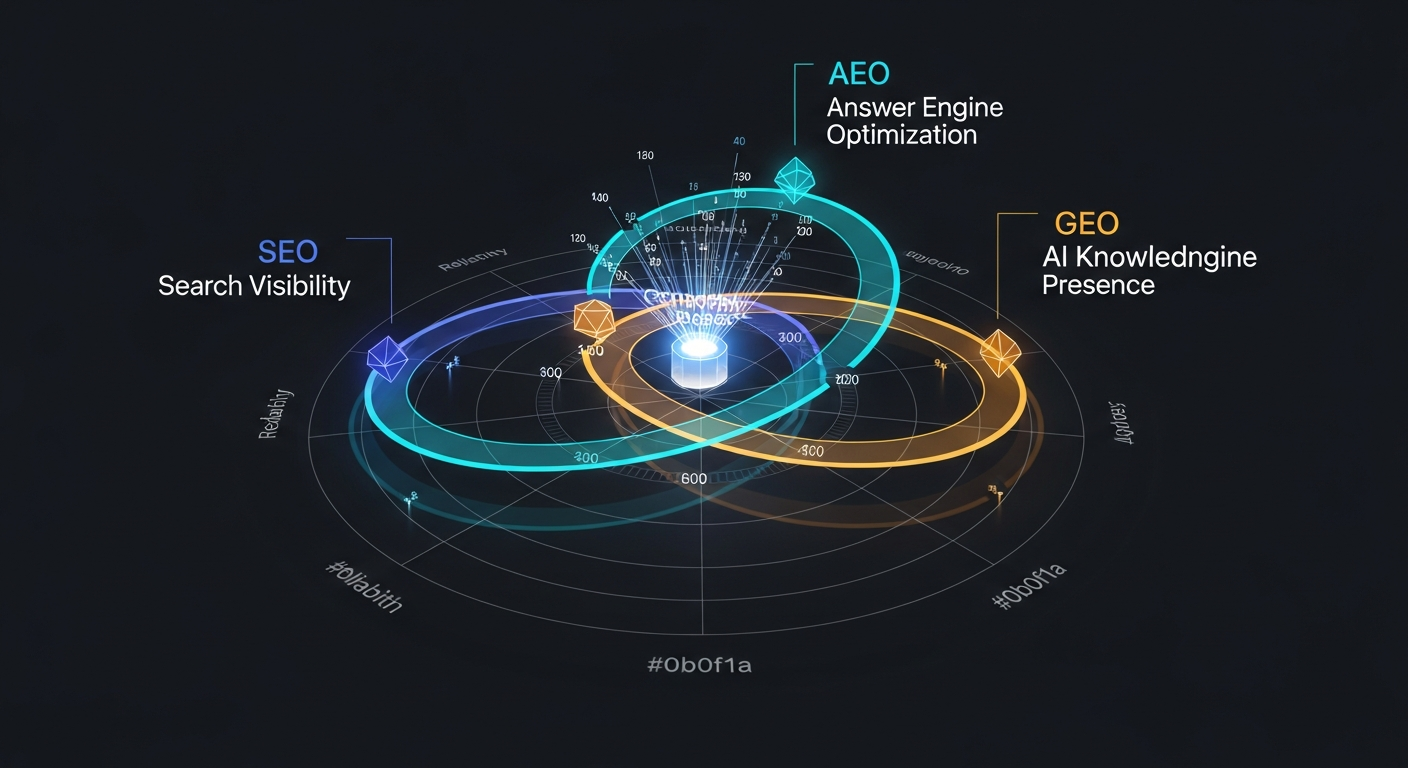
The AEGIS Index is a composite AI search visibility score that measures a brand's SEO, AEO, and GEO performance across 38 metrics, producing a single 0–100 score.
Formula: AEGIS Index = SEO×0.25 + AEO×0.25 + GEO×0.50
GEO carries double weight for a clear reason: generative AI search — ChatGPT, Gemini, Perplexity — is the primary future channel for brand visibility. Brands that AI cites organically will see disproportionate awareness gains as AI search grows.
38 Metrics — The Measurement Architecture
The AEGIS Index measures 38 items across three categories, each with a weight of ×1.0–×2.0.
SEO Metrics (13 items)
| Metric | Weight | Measurement Method |
|---|---|---|
| HTTPS enforcement | ×1.5 | T1 structural scan (measured) |
| Crawlability and indexation | ×2.0 | T1 robots.txt parsing |
| Canonical tag | ×1.2 | T1 HTML parsing |
| sitemap.xml structure | ×1.5 | T1 sitemap parsing |
| Title · meta description | ×1.2 | T1 HTML parsing |
| H1–H3 heading structure | ×1.2 | T1 + T2 (SPA correction) |
| Image alt text coverage | ×1.2 | T1 HTML parsing |
| Internal link density | ×1.2 | T1 HTML parsing |
| OG tags (og:title · og:image) | ×1.0 | T1 HTML parsing |
| Page speed signals | ×1.0 | T2 AI estimation |
| Mobile optimization | ×1.0 | T2 AI estimation |
| External backlink signals | ×1.5 | T2 Google Search Grounding |
| Domain authority signals | ×1.5 | T2 Google Search Grounding |
AEO Metrics (13 items)
| Metric | Weight | Measurement Method |
|---|---|---|
| FAQPage JSON-LD schema | ×1.5 | T1 HTML parsing |
| HowTo JSON-LD schema | ×2.0 | T1 HTML parsing |
| Organization JSON-LD | ×1.5 | T1 HTML parsing |
| Article / BlogPosting JSON-LD | ×1.5 | T1 HTML parsing |
| Person schema (E-E-A-T) | ×1.5 | T1 HTML parsing |
| Author profile · bio | ×1.5 | T2 AI analysis |
| Inverted-pyramid content structure | ×2.0 | T2 AI analysis |
| Direct-answer paragraph (under 50 words) | ×2.0 | T2 AI analysis |
| Featured Snippet optimization | ×1.5 | T2 Google Search Grounding |
| PAA (People Also Ask) coverage | ×1.2 | T2 Google Search Grounding |
| AI Overview citation presence | ×2.0 | T2 Google Search Grounding |
| Question-format titles · definitional sentences | ×1.5 | T2 AI analysis |
| Content depth · topical expertise | ×1.5 | T2 AI analysis |
GEO Metrics (12 items)
| Metric | Weight | Measurement Method |
|---|---|---|
| AI crawler allowance in robots.txt | ×2.0 | T1 robots.txt parsing |
| GPTBot · ClaudeBot · PerplexityBot listed | ×2.0 | T1 robots.txt parsing |
| Brand Entity construction | ×2.0 | T2 Google Search Grounding |
| Wikipedia / encyclopedic inclusion | ×2.0 | T2 Google Search Grounding |
| External media mentions | ×1.5 | T2 Google Search Grounding |
| Original research · proprietary data | ×1.5 | T2 AI analysis |
| sameAs social links (LinkedIn · GitHub) | ×2.0 | T1 HTML parsing |
| English-language content present | ×1.5 | T1 + T2 |
| hreflang multilingual declaration | ×1.2 | T1 HTML parsing |
| YouTube · multimedia assets | ×1.5 | T2 Google Search Grounding |
| Brand keyword co-occurrence patterns | ×1.5 | T2 Google Search Grounding |
| DefinedTerm schema (terminology authority) | ×2.0 | T1 HTML parsing |
Measurement Reliability — The T1 / T2 System
The most important quality characteristic of the AEGIS Index is its two-tier measurement architecture. A reliable diagnostic should produce consistent results when the same URL is measured twice under the same conditions.
T1: Direct Structural Scan (~100% Reproducibility)
T1 items are measured by AEGIS Insight's server directly parsing the target site's HTML, robots.txt, and sitemap.xml. No Gemini tokens are consumed, and the scan completes in approximately 3 seconds.
Key T1 characteristics:
- ~100% reproducibility: Results are identical as long as the code hasn't changed
- Immediate reflection: Deploy a change, remeasure, and see the difference the same day
- Zero AI estimation: Based on actual file content — no misinterpretation
Representative T1 items: FAQPage, HowTo, Organization JSON-LD; canonical; sitemap structure; robots.txt AI bot configuration; og:image; sameAs links
T2: Gemini AI + Google Search Grounding
T2 items are analyzed by Gemini 2.5 Flash + Google Search Grounding, with T1 real-measured values pre-injected into the analysis prompt. Compared to the original approach (AI estimation only, no T1 inputs), reproducibility on T1-covered items improved from ~55% to ~100%.
T2 characteristics:
- Some variability: Google Grounding results vary with real-time web state
- Indexation lag: External mentions and backlinks reflect changes after days to weeks
- Context-dependent: Accuracy improves significantly when brand name and keywords are entered
Critical Fail Gating Mechanisms
The AEGIS Index applies two gating mechanisms. Misunderstanding these leads to incorrect score interpretation.
Gate 1: SEO Critical Fail (SEO below 30)
When the SEO score falls below 30, AEGIS Index is forced to 0.
Rationale: AI crawlers that cannot reliably parse a site cannot process AEO or GEO signals. SEO below 30 means "inaccessible to the AI search ecosystem." Optimizing AEO and GEO without this foundation is meaningless.
Fix sequence: repair robots.txt → submit sitemap.xml → verify HTTPS → install Organization JSON-LD → rebuild technical SEO foundation.
Gate 2: SEO Range Coefficient (30 ≤ SEO < 50)
In the 30–50 SEO range, a coefficient reduces the AEGIS Index proportionally. Achieving SEO 50+ releases the coefficient and allows AEO and GEO items to contribute at full weight.
8-Scenario Interpretation Guide
The scenario delivered alongside the AEGIS Index score diagnoses "where you are now." Each scenario has a unique failure mode and shortest path to advancement.
| Scenario | Condition | Index Range | Core Problem | Shortest Path |
|---|---|---|---|---|
| S1 PHANTOM | SEO✗ AEO✗ GEO✗ | 0–25 | No technical foundation | Build technical SEO → S2 |
| S2 FOSSIL | SEO✓ AEO✗ GEO✗ | 15–30 | Invisible to AI search | AEO structured data → S6 |
| S3 MIRAGE | SEO✗ AEO✗ GEO✓ | 10–25 | No traffic inflow | Establish SEO → S7 |
| S4 EMBARGO | SEO✗ AEO✓ GEO✓ | 20–35 | Search blocked | Technical SEO → S8 immediately |
| S5 ORACLE | SEO✗ AEO✓ GEO✗ | 15–30 | SEO + GEO gaps | SEO → S6 → GEO → S8 |
| S6 STEALTH | SEO✓ AEO✓ GEO✗ | 45–60 | Not cited by generative AI | GEO external signals → S8 |
| S7 TITAN | SEO✓ AEO✗ GEO✓ | 55–70 | Not cited in AI answers | AEO schema → S8 |
| S8 AEGIS | SEO✓ AEO✓ GEO✓ | 65–100 | Maintain and expand | Quarterly re-diagnosis |
5 Things to Watch When Interpreting Results
1. Check the SPA Correction Flag
In React, Vue, or Next.js SPA environments without server-side rendering, crawlers may read H1/H2 as 0. AEGIS Insight auto-detects this and applies a correction disclaimer. If scores look anomalously low, check the SPA correction panel in the structural scan results.
2. Distinguish Static vs Dynamic Schema
JSON-LD embedded statically in index.html is captured immediately by T1 scanning. JSON-LD rendered by React components may not be detected if the page is crawled before JavaScript executes. To maximize AEO T1 scores, embed core schemas statically in index.html.
3. GSC Indexation Status and SEO Score
If your site isn't yet indexed by Google, SEO T2 items (external backlinks, domain authority) will score low. Submit sitemap.xml to Google Search Console and remeasure 1–2 weeks later after indexation propagates.
4. GEO Score Propagation Lag
GEO items including external media mentions, Wikipedia inclusion, and brand Entity signals take days to weeks to reflect in Google Grounding after actual changes occur. A GEO score not moving after short-term code changes is expected behavior.
5. Brand Name and Keyword Input Matters
Brand name and seed keyword inputs are optional in AEGIS Insight, but they significantly improve GEO analysis (external mentions, co-occurrence patterns) and AEO analysis (AI Overview citations, Featured Snippet detection). Always fill these in for accurate diagnosis.
Recommended Re-Measurement Cadence
The AEGIS Index is a continuous monitoring tool, not a one-time diagnostic. Use this cadence:
- Immediate: After changing T1 items (structured data, robots.txt, canonical)
- 2 weeks later: After GSC sitemap submission or new content publication
- 4–8 weeks later: After a blog series launch or internal link strengthening
- Quarterly: After reaching S8 AEGIS — to maintain scores and monitor competitors
Measure Your AEGIS Index Now
Enter your URL and brand name in AEGIS Insight. T1 structural scan and T2 AI analysis run automatically in sequence, delivering 38-metric scores, scenario classification, and a 90-day custom roadmap in under 5 minutes — free to use.
Frequently Asked Questions
Q.What formula calculates the AEGIS Index?
A.AEGIS Index = SEO×0.25 + AEO×0.25 + GEO×0.50. GEO carries double weight because generative AI search (ChatGPT, Gemini, Perplexity) is the primary future channel for brand visibility. An SEO score below 30 triggers Critical Fail gating, setting the AEGIS Index to 0 regardless of other scores.
Q.How are the 38 AEGIS Index metrics structured?
A.13 SEO metrics (technical structure, indexation, content, backlinks), 13 AEO metrics (structured data, E-E-A-T, Featured Snippet, intent matching), and 12 GEO metrics (brand Entity, external media, original research, AI crawler allowance). Each metric carries a weight of ×1.0–×2.0.
Q.What is the difference between T1 structural scan and T2 AI analysis?
A.T1 structural scanning directly parses the target site's HTML, sitemap.xml, and robots.txt server-side to capture ~100% reproducible real-measured values. T2 analysis runs Gemini 2.5 Flash + Google Search Grounding on top of those T1 inputs to assess the remaining metrics. T1 metric changes are visible immediately after deployment.
Q.What is the Critical Fail gating mechanism?
A.If the SEO score falls below 30, the entire AEGIS Index is gated to 0. AI crawlers that cannot reliably parse a site cannot process AEO or GEO signals, making those optimizations meaningless. An SEO score of 30–50 applies a gating coefficient that reduces the index score proportionally.
Q.Why does an SPA (React/Vue) site score lower on AEGIS Index?
A.SPAs without server-side rendering are crawled before JavaScript executes, causing H1/H2 tag counts to register as 0. AEGIS Insight automatically detects this and applies an SPA correction disclaimer. Embedding Organization, FAQPage, and HowTo JSON-LD statically in index.html ensures AEO T1 scores are captured correctly even without JS execution.
Q.How often should I remeasure the AEGIS Index?
A.For T1 items (structured data, robots.txt, canonical): remeasure immediately after deployment. After GSC sitemap submission or new content publication: remeasure 2 weeks later (GSC indexation lag). After blog series publication or internal link strengthening: remeasure 4–8 weeks later. After reaching S8 AEGIS: quarterly monitoring to maintain scores.
How to Apply This — Step by Step
- 1
Enter URL in AEGIS Insight
Navigate to /tools/insight and enter the URL you want to analyze, plus your brand name and seed keywords. Keyword input is optional but significantly improves AEO and GEO analysis accuracy.
- 2
Review T1 Structural Scan Results
After clicking ANALYZE, the T1 scan completes in ~3 seconds. Review HTTPS status, detected schema types, AI crawler allowance in robots.txt, and sitemap URL category classification — all real-measured values.
- 3
Interpret T2 AI Analysis
When Gemini analysis completes, review per-tab scores for SEO, AEO, and GEO. Note each metric's ✓/✗ status and weight to prioritize which items to fix first.
- 4
Execute Quick Wins First
Prioritize high-reproducibility T1 structural items: structured data schemas, robots.txt AI crawler allowance, canonical tags. Deploy changes and remeasure the same day to verify score improvement.
- 5
Follow the 90-Day Roadmap
Use the Gemini-generated 90-day roadmap: Month 1 (Quick Wins) → Month 2 (structural improvements) → Month 3 (target scenario achievement). Re-diagnose at each milestone.
More in AEO Insights