What Is AEO? — The Complete Guide to Answer Engine Optimization
AEO (Answer Engine Optimization) is the practice of structuring content so that AI answer engines — ChatGPT, Perplexity, Google AI Overview — select your brand as the cited source. This guide covers the definition, differences from SEO, and a 5-step execution framework.
Dohak Kim
Marketing Architect · Ph.D. in International Marketing (UIBE)
Published
2026-06-04
Summary
AEO (Answer Engine Optimization) is the strategy of optimizing content, structure, and authority so that AI answer engines select your brand as their cited source. Unlike SEO — which competes for rank positions — AEO competes for the single AI-generated response. The battleground has moved from keyword rankings to AI knowledge architecture.
What Is AEO? — The 30-Second Definition
AEO (Answer Engine Optimization) is the practice of optimizing content, structure, and authority so that AI answer engines — ChatGPT, Perplexity, Google AI Overview, Claude — select your brand as the cited source when generating responses to user questions.
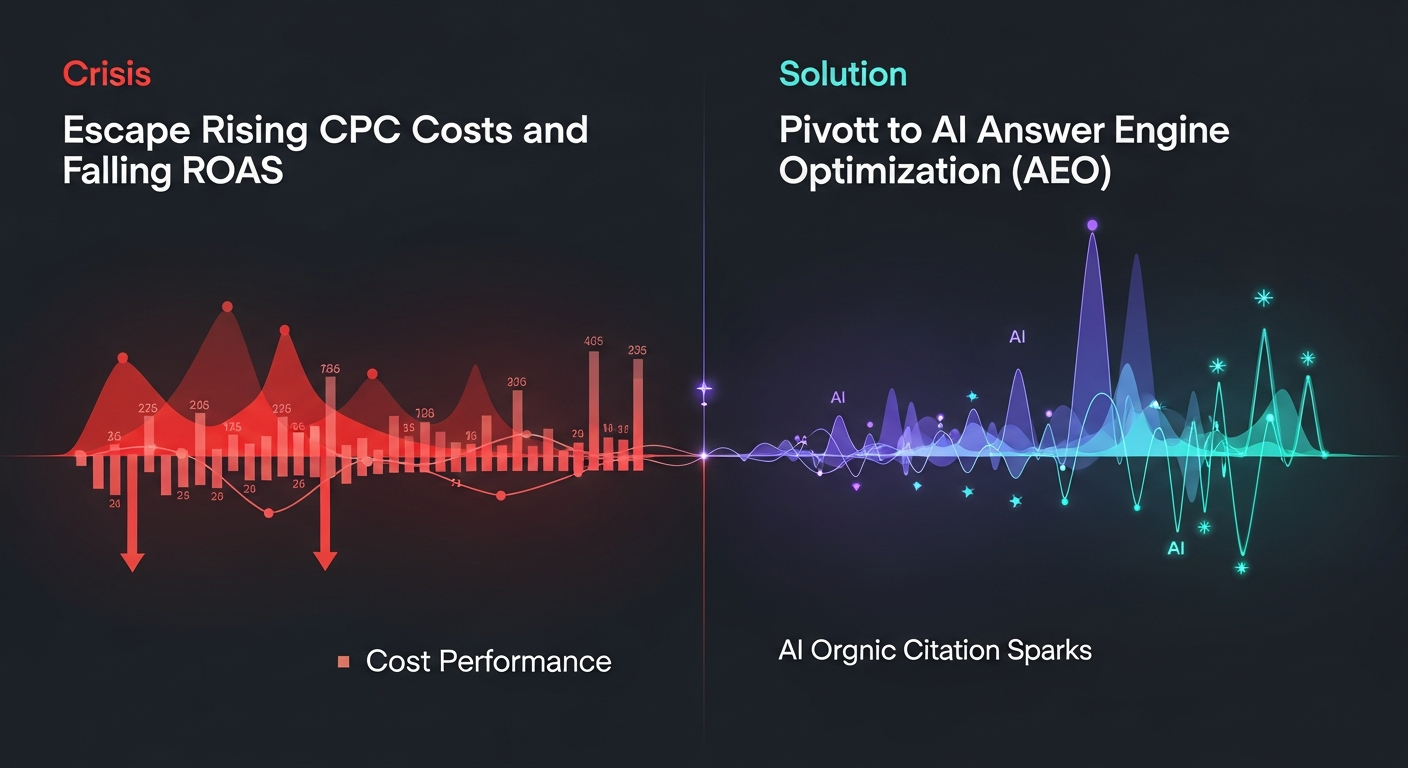
If SEO is "appearing at the top of search results," AEO is "being included in the single AI-generated answer." The goals sound similar but the mechanisms are fundamentally different.
Why AEO Matters Now
Search behavior changed structurally around 2024. Users no longer scan ten blue links — they ask AI a question and consume a single synthesized answer. ChatGPT, Google AI Overview, and Perplexity have made zero-click responses the new default.
The marketing implication is sharp:
- Brands not cited in AI responses are invisible to that entire channel of buyer intent
- SEO-only strategies leave brands absent from the fastest-growing query channel
- The gap between brands "known" to AI and brands "unknown" to AI is widening rapidly
Google's internal data shows that clicks on traditional blue links decline an average of 34% when AI Overview is displayed for a query. AEO is becoming a survival issue, not an optimization nice-to-have.
AEO vs SEO — The Core Differences
AEO and SEO are complementary, not competing — but their optimization mechanics are fundamentally different.
SEO objective: Rank at the top of SERPs and earn clicks. Keyword density, backlinks, page speed, and technical hygiene are the core levers.
AEO objective: Be selected as the cited source when AI generates a response. Structured data, E-E-A-T signals, and direct-answer content format are the core levers.
In the AEGIS Index, SEO and AEO each carry a ×0.25 weight. Both must be optimized together to achieve complete brand visibility in the AI search era.
The Three Core Components of AEO
1. Structured Data (JSON-LD Schema)
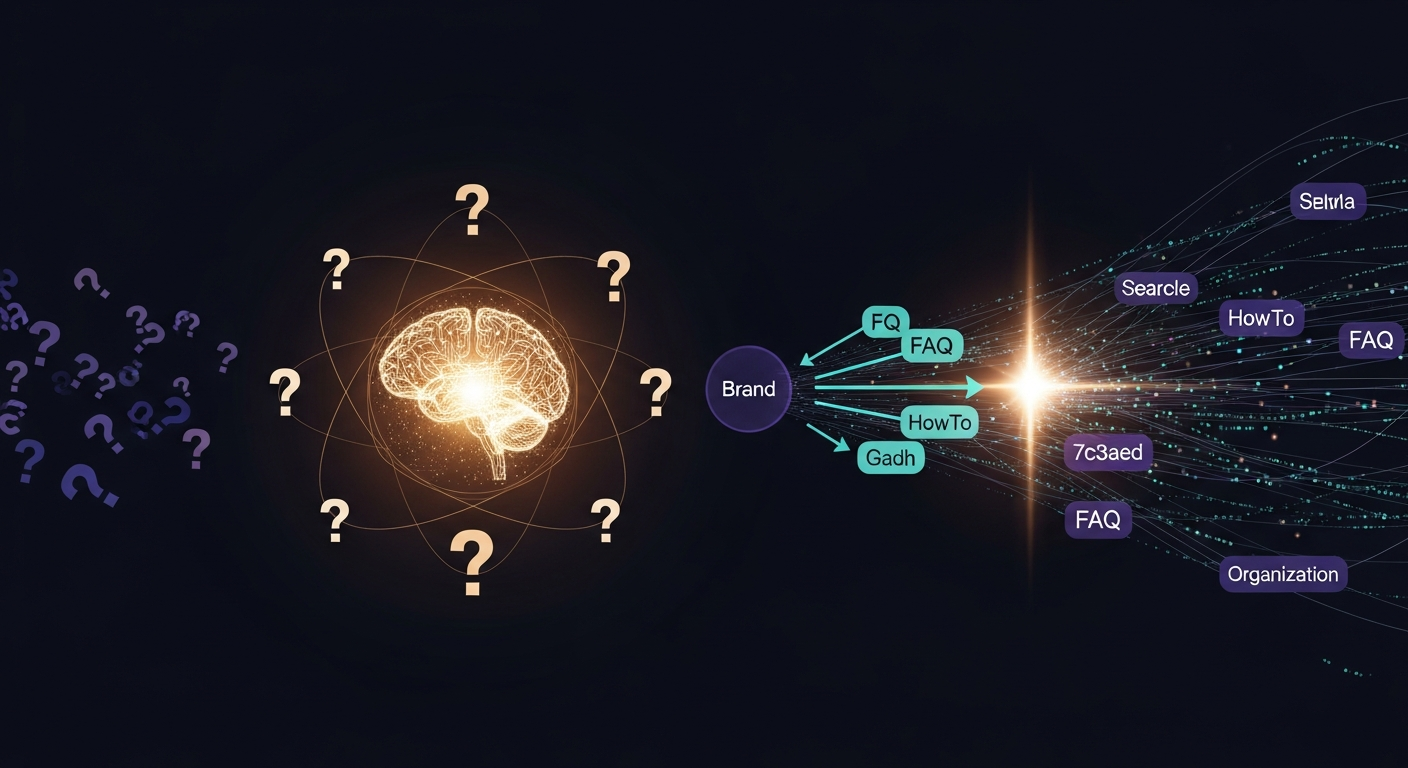
Structured data gives search and AI systems an explicit, machine-readable signal of what a page is and means — a supporting layer on top of good content, not a replacement for it. In the AEGIS scoring model, these schema types carry the highest AEO weight:
- FAQPage: Delivers Q&A content in a format AI can directly cite (AEO weight ×1.5)
- HowTo: Structures step-by-step guides for procedural queries (AEO weight ×2.0)
- Organization + Person: Communicates brand and author authority directly to AI crawlers
- Article + BlogPosting: Declares content topic, author, and publication date unambiguously
2. E-E-A-T (Experience, Expertise, Authoritativeness, Trustworthiness)
Both Google and AI answer engines weight "who wrote this" heavily. E-E-A-T signals go beyond general content quality — they verify that the author has real-world experience and domain expertise.
- Author bio: Mark up degrees, credentials, and career history with Person schema
- Attribution: Display author name and publication date clearly on every piece
- External citations: Cite academic sources, official statistics, and expert references
- UGC: Incorporate real user experience through case studies and reviews
3. Intent Matching
The core skill in AEO is predicting "what question will AI be asked, and what does the ideal answer look like" — then becoming the source of that answer. Content structure should follow the inverted pyramid:
- Opening paragraph: Direct answer in under 50 words (Featured Snippet target)
- Body: Evidence, supporting detail, and context in that order
- Headlines: "What is X," "How to X," "X vs Y" — question-format titles
5-Step AEO Strategy: Immediate Execution Order
Based on AEGIS Insight's 13 AEO metrics, ordered by implementation speed and impact:
Step 1: Install Static Schema (Immediate Impact)
In SPA frameworks (React, Vue), JavaScript executes after the initial crawler request. Embedding Organization, FAQPage, and HowTo JSON-LD statically in index.html delivers structured data to AI crawlers without requiring JS execution.
Step 2: Expand FAQ Content
Add 5–10 Q&A pairs to key pages with FAQPage schema. Write questions in the natural language format users actually ask AI — conversational, specific, context-rich. Start each answer with a direct response under 50 words.
Step 3: Build Author Authority
Mark up all author information using Person schema. Include verifiable credentials — degrees, publications, work history. Create a dedicated author profile page to concentrate E-E-A-T signals.
Step 4: Publish Definitional and Procedural Content
Continuously publish "What is X," "How to do X," and "X vs Y" format content. These formats map directly to the query patterns AI answer engines receive most frequently, and they are the types AI cites most often in responses.
Step 5: Measure and Iterate
Diagnose your AEO score with AEGIS Insight and execute Quick Wins in sequence. T1 (structural) items update in real-time — deploy the change, re-run the diagnosis, and see the score move the same day.
Realistic AEO Timeline
AEO delivers faster visible results than SEO in some areas. Structural data (T1 items) is recognized by AI crawlers immediately after deployment. Authority signals (E-E-A-T, external citations) accumulate over months.
- Immediate (0–1 week): Structured data installed → T1 score rises immediately
- Short-term (1–4 weeks): FAQ and HowTo content published → 10–20 point AEO score increase expected
- Medium-term (1–3 months): E-E-A-T strengthened, external citations begin → authority signals accumulate
- Long-term (3+ months): Featured Snippet placements, AI answer citations begin appearing
Diagnose Your AEO Score Now
AEGIS Insight automatically diagnoses 13 AEO metrics using Gemini 2.5 Flash + Google Search Grounding, delivering your current position (S1 PHANTOM–S8 AEGIS), a tailored improvement prescription, and a 90-day roadmap. Enter any URL and get results in 5 minutes.
Frequently Asked Questions
Q.What is AEO (Answer Engine Optimization)?
A.AEO is the practice of optimizing content so that AI answer engines — ChatGPT, Perplexity, Google AI Overview, Claude — select your brand as the cited source when generating responses to user questions. FAQPage and HowTo JSON-LD structured data, E-E-A-T (Experience, Expertise, Authoritativeness, Trustworthiness) signals, and direct-answer paragraph structure are the core levers.
Q.What is the difference between AEO and SEO?
A.SEO targets rank positions on search results pages (SERPs) and drives click traffic. AEO targets the single AI-generated answer and aims to be the cited source inside that answer. SEO is a ranking competition; AEO is a positioning competition within AI knowledge systems.
Q.What is the most important technical element for AEO?
A.FAQPage, HowTo, Article, and Organization JSON-LD schema markup deliver the most immediate impact. AI answer engines use structured data to rapidly assess a page's intent and authority. FAQPage schema carries an AEO weight of ×1.5 in the AEGIS scoring model.
Q.How does E-E-A-T affect AEO performance?
A.E-E-A-T (Experience, Expertise, Authoritativeness, Trustworthiness) is the primary signal AI answer engines use to select citation sources. Marking up author credentials — degrees, professional history, publications — with Person schema, and producing content grounded in real-world experience, directly raises your AEO score.
Q.How do I measure my AEO score?
A.AEGIS Insight diagnoses 13 AEO metrics (Organization, FAQ, HowTo schema, E-E-A-T, Featured Snippet readiness, and more) using Gemini + Google Search Grounding, returning a 0–100 AEO score for any URL in about 5 minutes.
Q.Can I start AEO without existing content?
A.Yes — start with technical foundations first. Statically embedding Organization, FAQPage, and HowTo JSON-LD in index.html lets you raise T1 (structure) metric scores immediately, before any content is published. Long-term, however, AEO scores above 60 require high-quality written content.
How to Apply This — Step by Step
- 1
Install Structured Data
Statically embed Organization, WebSite, and Person JSON-LD in index.html. In React/Vue SPAs, static schema in the HTML shell is crawled before JavaScript executes — this is the highest-impact first step.
- 2
Structure FAQ Content
Add FAQPage JSON-LD to key pages and write Q&A sections in inverted-pyramid format: direct answer in the first sentence (under 50 words), followed by supporting detail. AI answer engines strongly prefer direct answers over explanatory preambles.
- 3
Build E-E-A-T Signals
Mark up author bios — degrees, credentials, career history — using Person schema. Add contact information and company details with Organization schema. Cite authoritative external sources and disclose methodology to build trust signals.
- 4
Produce Definitional Content
Publish "What is X," "How to do X," and "X vs Y" content formats. AI answer engines cite this type of content most frequently when generating responses — these are the formats that map directly to high-intent queries.
- 5
Diagnose and Iterate
Run AEGIS Insight to score your AEO performance and execute Quick Wins in priority order. T1 (structural) fixes take effect immediately after deployment and can be re-measured the same day.
More in AEO Insights